 by our College Data Analytics Team
Below are the key facts about graduate study in ecology & systematics biology at Harvard University. It is offered at the Master’s, Doctoral levels, with undergraduate study also available. It ranks as high as #1 out of 5 schools (Master’s level) by College Factual. Jump to any of the following sections:
By College Factual’s measure, Harvard University as a strong choice for ecology & systematics biology, placing at #6 out of 148 schools nationally.
The following degree levels are offered in ecology & systematics biology at Harvard University, along with how many graduates complete each level annually.
| Degree Level | Annual Graduates |
|---|---|
| Bachelor’s | 76 |
| Master’s | 109 |
| Doctoral | 44 |
During the most recent reporting year, Harvard University handed out 109 master’s degrees in ecology & systematics biology.
Harvard University is among the very best schools in the country for ecology & systematics biology at the master’s level. In particular it placed #1 out of 5 schools by College Factual.
Information about average full-time graduate tuition and fees is shown in the table below.
| In State | Out of State | |
|---|---|---|
| Tuition | $77,100 | $77,100 |
| Fees | $1,592 | $1,592 |
Read more about Harvard University tuition and fees.
In the most recent graduating class, 33% of ecology & systematics biology master’s degrees went to men and 67% went to women.
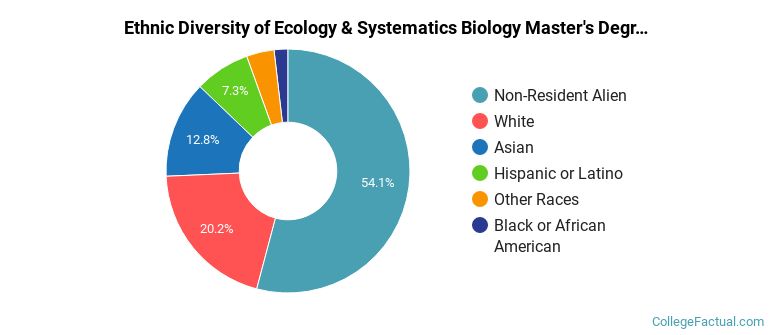
 The majority of ecology & systematics biology master’s degree graduates at Harvard University are Non-Resident Alien. About 54% of graduates fell into this category.
The following table and chart show the ethnic background for students who recently graduated from Harvard University with a master’s in ecology & systematics biology.
| Ethnic Background | Number of Students |
|---|---|
| Asian | 14 |
| Black or African American | 2 |
| Hispanic or Latino | 8 |
| White | 22 |
| Non-Resident Aliens | 59 |
| Other Races | 4 |
Harvard University granted 103 master’s degrees in epidemiology recently — 67% to women and 33% to men. The most common background among these graduates was Non-Resident Alien (55%).
Harvard University granted 5 master’s completions in systematic biology/biological systematics in the latest year of data — 60% to women and 40% to men. Most of these graduates identified as Non-Resident Alien (40%).
Harvard University conferred 1 master’s degree in evolutionary biology recently — 100% to women and 0% to men. Most of these graduates identified as White (100%).
During the most recent reporting year, Harvard University awarded 44 doctoral degrees in ecology & systematics biology.
Harvard University is among the very best schools in the country for ecology & systematics biology at the doctoral level. In particular it placed #1 out of 2 schools by College Factual.
Among recent graduates, 34% of ecology & systematics biology doctoral degrees went to men and 66% went to women.
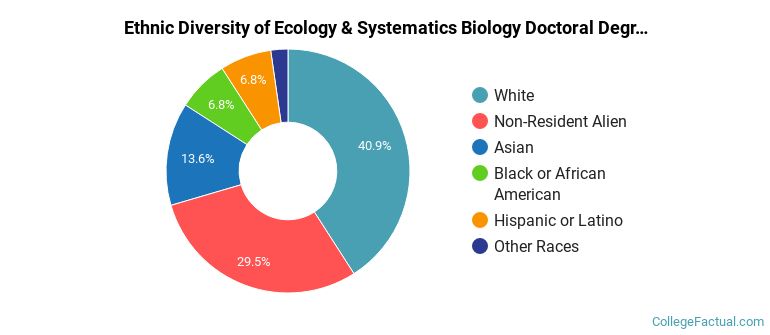
 The majority of ecology & systematics biology doctoral degree graduates at Harvard University were White. About 41% of graduates fell into this category.
The following table and chart show the ethnic background for students who recently graduated from Harvard University with a doctoral in ecology & systematics biology.
| Ethnic Background | Number of Students |
|---|---|
| Asian | 6 |
| Black or African American | 3 |
| Hispanic or Latino | 3 |
| White | 18 |
| Non-Resident Aliens | 13 |
| Other Races | 1 |
Harvard University awarded 31 doctoral completions in epidemiology in the most recent reporting year — 71% to women and 29% to men. The largest share of these graduates were White (42%).
Harvard University awarded 13 doctoral degrees in systematic biology/biological systematics in the latest year of data — 54% to women and 46% to men. Most of these graduates identified as White (38%).
Undergraduate study is also available at Harvard University. Here are the undergraduate award levels offered.
| Undergraduate Level | Annual Graduates |
|---|---|
| Bachelor’s Degrees in Ecology & Systematics Biology | 76 |